
Spaces:
Sleeping

Sleeping
| title: MSE | |
| emoji: 🤗 | |
| colorFrom: blue | |
| colorTo: red | |
| sdk: gradio | |
| sdk_version: 3.19.1 | |
| app_file: app.py | |
| pinned: false | |
| tags: | |
| - evaluate | |
| - metric | |
| description: >- | |
| Mean Squared Error(MSE) is the average of the square of difference between the predicted | |
| and actual values. | |
| # Metric Card for MSE | |
| ## Metric Description | |
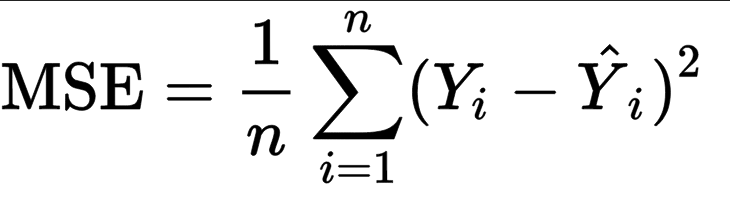
| Mean Squared Error(MSE) represents the average of the squares of errors -- i.e. the average squared difference between the estimated values and the actual values. | |
|  | |
| ## How to Use | |
| At minimum, this metric requires predictions and references as inputs. | |
| ```python | |
| >>> mse_metric = evaluate.load("mse") | |
| >>> predictions = [2.5, 0.0, 2, 8] | |
| >>> references = [3, -0.5, 2, 7] | |
| >>> results = mse_metric.compute(predictions=predictions, references=references) | |
| ``` | |
| ### Inputs | |
| Mandatory inputs: | |
| - `predictions`: numeric array-like of shape (`n_samples,`) or (`n_samples`, `n_outputs`), representing the estimated target values. | |
| - `references`: numeric array-like of shape (`n_samples,`) or (`n_samples`, `n_outputs`), representing the ground truth (correct) target values. | |
| Optional arguments: | |
| - `sample_weight`: numeric array-like of shape (`n_samples,`) representing sample weights. The default is `None`. | |
| - `multioutput`: `raw_values`, `uniform_average` or numeric array-like of shape (`n_outputs,`), which defines the aggregation of multiple output values. The default value is `uniform_average`. | |
| - `raw_values` returns a full set of errors in case of multioutput input. | |
| - `uniform_average` means that the errors of all outputs are averaged with uniform weight. | |
| - the array-like value defines weights used to average errors. | |
| - `squared` (`bool`): If `True` returns MSE value, if `False` returns RMSE (Root Mean Squared Error). The default value is `True`. | |
| ### Output Values | |
| This metric outputs a dictionary, containing the mean squared error score, which is of type: | |
| - `float`: if multioutput is `uniform_average` or an ndarray of weights, then the weighted average of all output errors is returned. | |
| - numeric array-like of shape (`n_outputs,`): if multioutput is `raw_values`, then the score is returned for each output separately. | |
| Each MSE `float` value ranges from `0.0` to `1.0`, with the best value being `0.0`. | |
| Output Example(s): | |
| ```python | |
| {'mse': 0.5} | |
| ``` | |
| If `multioutput="raw_values"`: | |
| ```python | |
| {'mse': array([0.41666667, 1. ])} | |
| ``` | |
| #### Values from Popular Papers | |
| ### Examples | |
| Example with the `uniform_average` config: | |
| ```python | |
| >>> mse_metric = evaluate.load("mse") | |
| >>> predictions = [2.5, 0.0, 2, 8] | |
| >>> references = [3, -0.5, 2, 7] | |
| >>> results = mse_metric.compute(predictions=predictions, references=references) | |
| >>> print(results) | |
| {'mse': 0.375} | |
| ``` | |
| Example with `squared = True`, which returns the RMSE: | |
| ```python | |
| >>> mse_metric = evaluate.load("mse") | |
| >>> predictions = [2.5, 0.0, 2, 8] | |
| >>> references = [3, -0.5, 2, 7] | |
| >>> rmse_result = mse_metric.compute(predictions=predictions, references=references, squared=False) | |
| >>> print(rmse_result) | |
| {'mse': 0.6123724356957945} | |
| ``` | |
| Example with multi-dimensional lists, and the `raw_values` config: | |
| ```python | |
| >>> mse_metric = evaluate.load("mse", "multilist") | |
| >>> predictions = [[0.5, 1], [-1, 1], [7, -6]] | |
| >>> references = [[0, 2], [-1, 2], [8, -5]] | |
| >>> results = mse_metric.compute(predictions=predictions, references=references, multioutput='raw_values') | |
| >>> print(results) | |
| {'mse': array([0.41666667, 1. ])} | |
| """ | |
| ``` | |
| ## Limitations and Bias | |
| MSE has the disadvantage of heavily weighting outliers -- given that it squares them, this results in large errors weighing more heavily than small ones. It can be used alongside [MAE](https://huggingface.co/metrics/mae), which is complementary given that it does not square the errors. | |
| ## Citation(s) | |
| ```bibtex | |
| @article{scikit-learn, | |
| title={Scikit-learn: Machine Learning in {P}ython}, | |
| author={Pedregosa, F. and Varoquaux, G. and Gramfort, A. and Michel, V. | |
| and Thirion, B. and Grisel, O. and Blondel, M. and Prettenhofer, P. | |
| and Weiss, R. and Dubourg, V. and Vanderplas, J. and Passos, A. and | |
| Cournapeau, D. and Brucher, M. and Perrot, M. and Duchesnay, E.}, | |
| journal={Journal of Machine Learning Research}, | |
| volume={12}, | |
| pages={2825--2830}, | |
| year={2011} | |
| } | |
| ``` | |
| ```bibtex | |
| @article{willmott2005advantages, | |
| title={Advantages of the mean absolute error (MAE) over the root mean square error (RMSE) in assessing average model performance}, | |
| author={Willmott, Cort J and Matsuura, Kenji}, | |
| journal={Climate research}, | |
| volume={30}, | |
| number={1}, | |
| pages={79--82}, | |
| year={2005} | |
| } | |
| ``` | |
| ## Further References | |
| - [Mean Squared Error - Wikipedia](https://en.wikipedia.org/wiki/Mean_squared_error) | |